
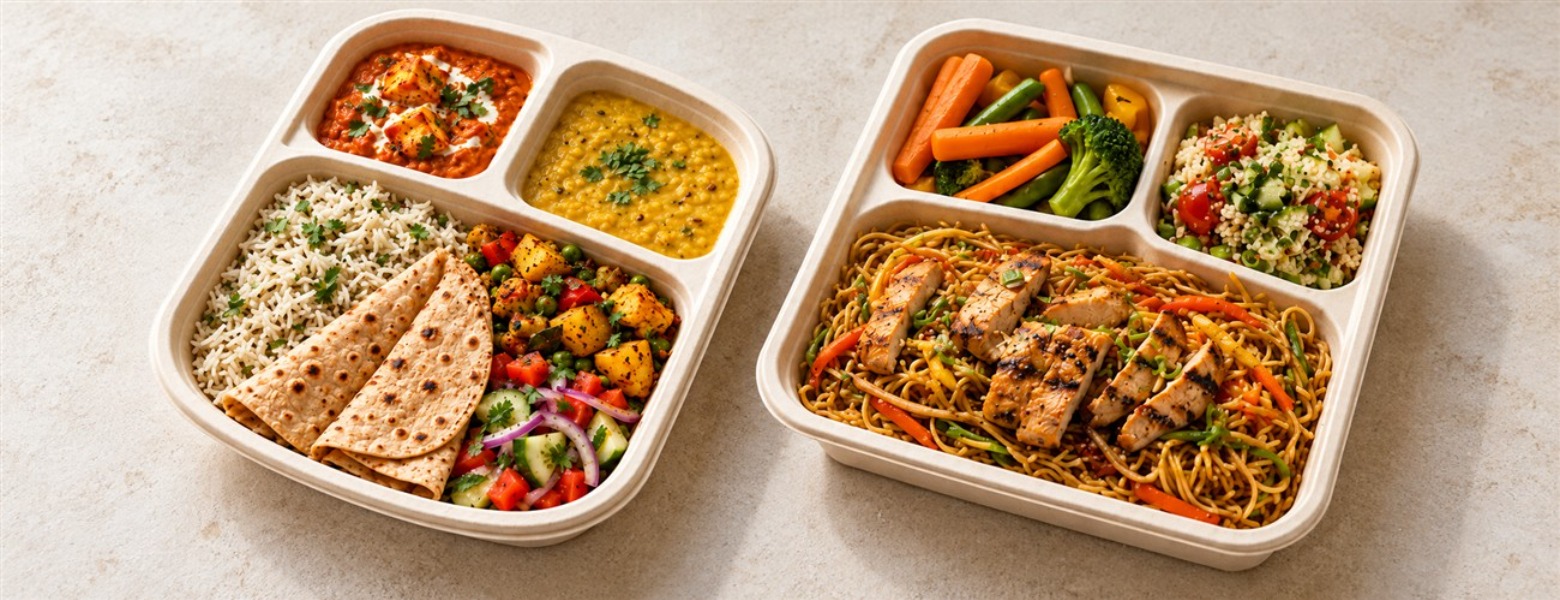
Choosing corporate catering in Bangalore means choosing how your office will eat every working day: what arrives, how employees choose it, who manages the orders and what happens when attendance changes. A good arrangement fits your space, provides a complete lunch and keeps delivery, food waste and administration under control.
This guide compares vendor types, meal boxes, cafeterias, software and costs, with practical checks for choosing the right partner. Carb Theory publishes the guide and is included in the provider comparison.
Understand the different types of food vendors
| Vendor type | What the model involves |
|---|---|
| 1. Managed cafeteria operator | Runs onsite dining, counters and serving operations. Needs suitable premises and an agreed staffing, equipment and cleaning plan. |
| 2. Daily corporate meal specialist | Prepares recurring office meals in a central kitchen and delivers boxes or bulk food. Focuses on repeat menus, ordering and scheduled routes. |
| 3. Bulk food supplier | Delivers food in shared containers. Your office or a contracted team handles serving, portions and cleanup. |
| 4. Event caterer | Plans a particular meeting, celebration or conference. May provide buffets, equipment, live counters and staff. |
| 5. Restaurant or delivery aggregator | Useful for occasional choice and small orders. Check whether recurring billing, coordinated arrival and employee meal administration are included. |
| 6. Cafeteria technology platform | Connects ordering, payments and food partners. Establish who cooks, delivers, checks quality and resolves complaints. |
Some companies cover several categories. An event specialist may also run daily lunches, but ask for evidence of consistent weekday service. Event presentation and a recurring employee meal programme require different planning.
Choose the format around your office space
- No kitchen or serving counter: Individually packed meals are usually the simplest starting point. You still need a clean handover area, distribution plan and waste bins.
- Pantry and dining space, but no cooking facilities: Consider delivered bulk meals with a staffed counter. Account for safe holding equipment, utensils, washing and cleanup.
- Suitable kitchen and steady attendance: Evaluate a managed cafeteria, including utilities, maintenance, staffing and food-safety responsibilities.
- Hybrid attendance or several small offices: Pre-ordered boxes can make changing counts easier to manage. Confirm location minimums and the cost of each delivery.
Meal boxes make individual allocation and dietary labels easier. Bulk service allows flexible serving sizes and can reduce individual packaging, but poor forecasting or oversized servings can increase waste. A cafeteria provides a dining experience but adds operating commitments. Compare the full system rather than assuming one format is always cheaper.
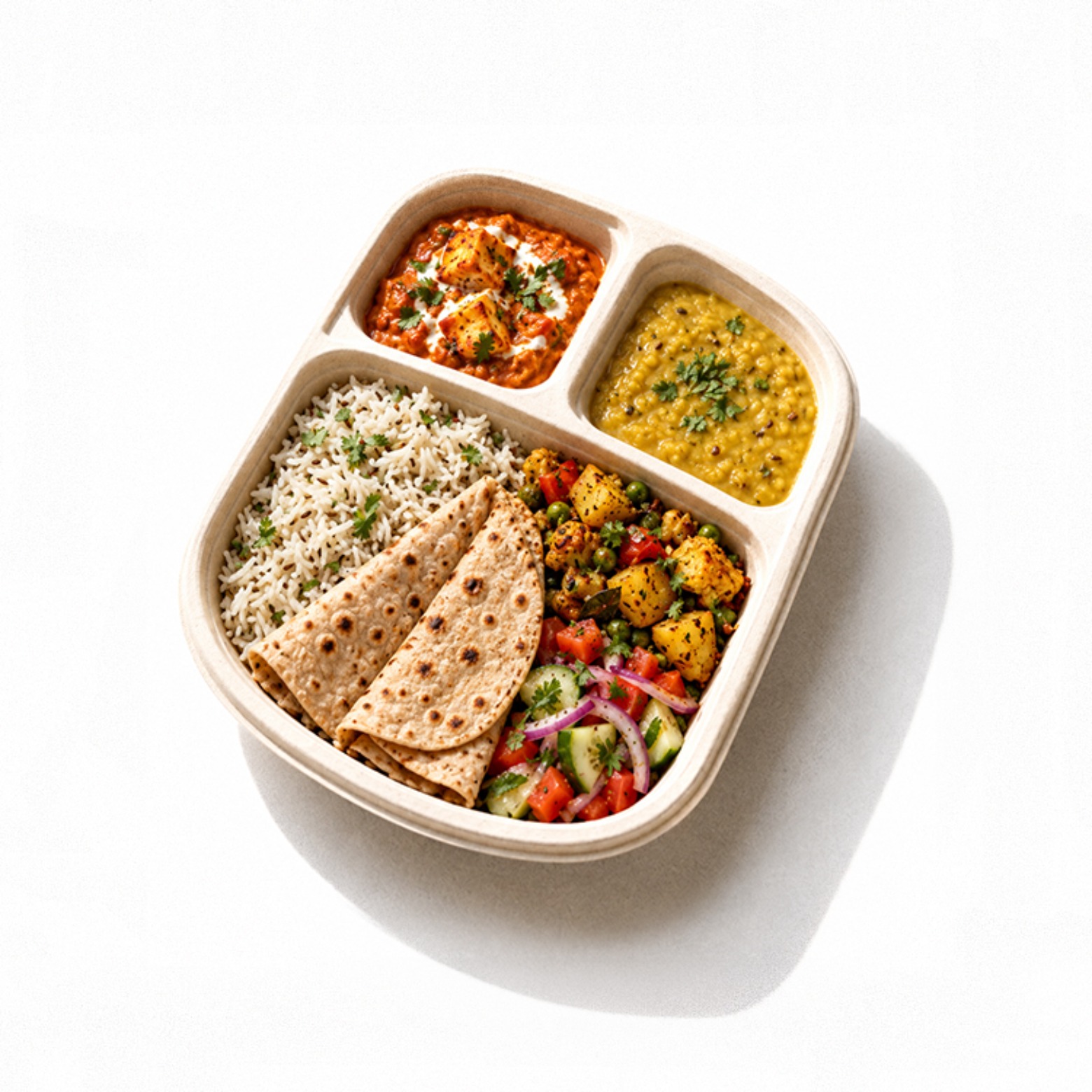
Check that meal boxes are food-grade, suitable for the food temperature, secure during transport and clearly labelled. Compartments should keep wet and dry items usable when lunch arrives. Carb Theory uses cornstarch-based packaging for its principal meal formats; confirm the materials for accessories and the available disposal route rather than assuming every item is compostable.
A complete lunch is about composition, not quantity
A large serving of rice with a little vegetable garnish does not, by itself, demonstrate a balanced lunch. Ask what makes up the meal, especially the protein portion and vegetables. The WHO's healthy-diet guidance emphasises adequacy, balance, moderation and variety, rather than food volume alone.
- Protein: Look for a meaningful serving of dal, beans, chickpeas, soya, tofu, paneer, eggs, fish or chicken, suited to the menu and employee's diet.
- Vegetables and fibre: Check the actual portion and variety, alongside suitable grains, pulses or other fibre sources.
- Carbohydrates and fats: Rice, roti and other staples can belong in a balanced meal. Consider their quantity, preparation and what accompanies them.
- Portion suitability: Employees have different appetites and needs. Compare sample meals and ask how portions or optional extras are handled.
A modestly priced dal, grain and vegetable meal can offer good value. A premium label or an oversized box does not prove nutritional quality. Where macro information is provided, ask whether it describes the actual recipe and serving.
For staff well-being, combine enjoyable food with a regular lunch break, drinking water, dietary inclusion and feedback. Avoid promising that a meal plan will prevent illness, guarantee weight loss or solve fatigue. Individual medical diets require appropriate professional advice.
Offer multiple menus without making ordering harder
A single fixed meal will not suit every employee every day. Compare the choices available on the same day, the weekly rotation, vegetarian and non-vegetarian availability, and the process for special requirements.
Carb Theory offers Indian thali and Standard/Global meal options, with rotating Indian, Continental and global dishes. Employees choose from the day's available menu through the ordering platform. Check the current menu rather than assuming every cuisine or dish is available daily.
For vegan, Jain, gluten-related or allergy requirements, specify ingredients to avoid and confirm availability and preparation arrangements. “Vegetarian” or “healthy” is not a substitute for an allergen discussion. If a kitchen cannot meet a requirement safely, agree on an alternative before onboarding.
How meal management software reduces HR headaches
Collecting everyone's lunch preferences through messages creates work beyond ordering food. HR has to reconcile leave, changing preferences, add-ons, headcounts and invoice queries. Carb Theory combines the food service with its own browser-based meal management platform, included with corporate meal plans rather than sold as standalone software.
| Common HR headache | Carb Theory's approach |
|---|---|
| Chasing meal choices in chat | Employees choose their own meals and add-ons from the available menu. |
| Maintaining signup and preference lists | Employees sign up and set preferences; HR can see who has joined and follow up with those who have not. |
| Combining daily counts manually | HR and managers see team orders and headcount in one place, with changes governed by the agreed cutoff. |
| Checking who ordered what | Order and delivery records provide a reference for day-specific questions. |
| Reconciling the meal invoice | Records support the 15-day invoice; company-paid, employee-paid and subsidised arrangements can be configured. |
The benefit is a clearer ordering process, not a promise that all coordination disappears. Someone still needs to manage office access, exceptions and escalation. Ask for a demonstration using your team's actual workflow.
Software is not unique to Carb Theory: HungerBox, GoKhana and SmartQ offer cafeteria technology, and some meal suppliers provide dashboards. The useful comparison is which features come with the food service and how well they work for your office.
What does corporate catering cost in Bangalore?
Compare complete quotes for the same menu, headcount and service format. Published examples include Sri Lakshmi's vegetarian corporate boxes at ₹150–₹300, Carb Theory meals from ₹250, and GoCaters thali boxes from ₹349. These are different offers, not a citywide average or like-for-like quality ranking.
Illustrative monthly food budgets, assuming 22 working days
| Meals/day | Assumed rate | Monthly food cost |
|---|---|---|
| 25 | ₹180 | ₹99,000 |
| 50 | ₹250 | ₹2,75,000 |
| 100 | ₹250 | ₹5,50,000 |
| 100 | ₹350 | ₹7,70,000 |
| 300 | ₹250 | ₹16,50,000 |
These calculations exclude separately charged delivery, taxes, extras, staffing and setup. Carb Theory's standard minimum is 10 meals a day. Its delivery charge is ₹100–₹300 per delivery to one location, with possible waivers for nearby orders. Confirm the final route and quote.
For example, one ₹200 delivery on each of 22 days adds ₹4,400 monthly. Multiple offices or meal slots may mean multiple charges. Protein portions, ingredients, packaging and dependable delivery all affect value; judge the lunch employees receive, not only the lowest headline price.
Food waste can change the real cost of lunch
A lower per-box price does not guarantee a lower food bill. Unplanned leave, duplicated orders, unpopular menus and unsuitable portions can leave paid meals unused. Even a capable supplier cannot fix inaccurate counts without a workable ordering process.
Illustrative example: An office orders 100 lunches at ₹250 each, but only 90 are eaten. Food spend is ₹25,000 a day, or about ₹278 per consumed lunch before delivery. Ten unused lunches each day over 22 working days represent ₹55,000 of purchased meals. This is a planning example, not measured Carb Theory savings or an estimate of all plate waste.
- Use confirmed selections instead of a fixed attendance guess, allowing changes before the cutoff.
- Record unopened meals separately from serving leftovers and food left on plates.
- Check why meals are unused: absence, timing, taste, portion size or dietary mismatch require different fixes.
- Review trends with the supplier and adjust menus, counts or portions without underfeeding the team.
Carb Theory's ordering records can support more accurate counts, but minimum orders and late-change rules still apply. Meal boxes also create packaging waste; bulk service can reduce packaging but needs controlled portions and safe handling. Measure both rather than assuming either format produces zero waste. The UNEP Food Waste Index report provides wider context on measuring food waste.
Check freshness, delivery and the food that actually arrives
Ask where meals are cooked, when preparation begins, whether prepared dishes are chilled or frozen for later service, and how dispatch and handover are managed. “Fresh” should describe a clear process, not just an advertising word.
At Carb Theory, preparation starts at 5 a.m. We cook meals in our kitchen and deliver them the same day through our own fleet, rather than freezing prepared meals for later service. This describes our prepared-meal process; it is not a claim that every raw ingredient has never been frozen.
A properly controlled chilled or frozen process is not automatically unsafe. What matters is honest disclosure, appropriate storage, thawing, reheating and transport controls. FSSAI's catering guidance is a useful reference when reviewing the vendor's process.
During a trial, inspect the delivered meal, not only a kitchen tasting:
- Check dispatch and arrival times, appropriate temperature controls and clean, covered carriers.
- Look for intact food-grade packaging, leakage, correct labels and separation of incompatible foods.
- Compare taste, texture, portions and vegetables with the agreed sample across several days.
- Agree on a receiving contact, safe holding instructions and when food should be eaten or stored.
- Set a clear escalation route for a missed delivery, missing box, incorrect meal or food-safety concern, including the agreed remedy.
Carb Theory's normal lunch window is 11:30 a.m.–1:00 p.m.; other slots and address-specific arrangements need confirmation. Review the delivery areas and building handover requirements. Same-day cooking does not remove the need for safe transport and timely service.
Verify licensing, hygiene and dietary safeguards
Ask for current FSSAI licence or registration details and verify the business and preparation premises through the official FoSCoS portal. A website badge does not establish current compliance or daily performance.
If additional food-safety certifications are claimed, check their issuer, validity and scope. Review cleaning, pest control, staff handling practices, ingredient traceability, allergen procedures and complaint records. Confirm who is accountable if a food partner or subcontracted kitchen is involved.
For severe allergies or clinical dietary needs, do not rely on a menu label alone. Establish whether the kitchen can meet the requirement, including cross-contact controls, before making promises to employees.
Trial the service and agree on onboarding
Carb Theory offers a one-week trial. Confirm the menu, headcount, price, delivery charges and dates; the trial is not assumed to be free. Use it to test food quality, menu variety, punctuality, ordering and complaint resolution.
- Brief: Share the address, attendance pattern, meal slots, budget and dietary mix.
- Agree: Confirm menu choices, minimum orders, total charges, invoice details and service terms.
- Set up: Let employees join the platform, set preferences and understand deadlines; HR checks signup and exceptions.
- Review: Record delivery performance, employee feedback and unused meals before starting the regular plan.
Carb Theory's final-count cutoff is 6:30 p.m. on the previous day; same-day additions are unavailable. Billing runs on a 15-day cycle with consolidated GST invoices. Accounts above 100 boxes a day require one month's notice before starting or stopping. Confirm current terms in the written agreement.
Corporate catering providers and platforms to compare
The numbered list is for navigation, not a ranking. These providers and brands serve different needs; confirm availability for your exact Bangalore office. Some belong to the same group, so the list is not a count of independent companies.
| Provider | Service to evaluate |
|---|---|
| 1. Carb Theory | Same-day corporate meal delivery, multiple menu options and included employee/HR meal management; office events and wellness services. |
| 2. Work Food | Daily bento boxes, bulk lunch delivery and live counters. |
| 3. MomoChutney | Corporate lunch subscriptions, bulk service, individual boxes and an admin dashboard. |
| 4. Panache Platform | Packaged corporate meals and event boxes, with published pre-ordering and meal-tracking features. |
| 5. CaterNinja | Group and event catering; check the exact box, buffet or counter package. |
| 6. Sri Lakshmi Caterers | Vegetarian catering and corporate meal boxes with published indicative prices. |
| 7. GoCaters | Packed meals for daily office subscriptions and events. |
| 8. GoKhana | Cafeteria technology and managed food programmes. |
| 9. HungerBox | Enterprise cafeteria operations and digital food ordering. |
| 10. SmartQ | Workplace dining management and food technology; part of Compass Group. |
| 11. Sodexo India | Onsite corporate dining and broader food-service operations. |
| 12. Compass Group India | Institutional and workplace food services, including dining and event formats. |
| 13. Elior India | Central-kitchen and onsite corporate food services, including its Megabite and Platesmith offerings. |
Provider descriptions reflect their own published services, not independent quality audits. Request the same menu brief, safety evidence, software demonstration and trial criteria from each shortlist candidate. A technology platform should also identify the food partner actually serving you.
When does a cafeteria make more sense?
A cafeteria can suit a workplace with reliable attendance, usable dining space and a need for several food counters or service windows. It can create a shared lunch space and support flexible portions. That does not mean every growing office needs one.
For onsite cooking, assess kitchen suitability, ventilation, water, drainage, power, equipment and compliance before choosing an operator. For delivered food served onsite, agree on holding equipment, service staff, dishwashing, cleaning and leftover handling. A dining room without a kitchen can still support this second model.
Request a full operating budget: food, labour, utilities, equipment, maintenance, cleaning, space and minimum commitments. Check queues, counter capacity, portion controls and actual participation during a pilot. A cafeteria with low take-up or poorly planned production can cost more than expected.
If you lack the space or stable demand, delivered meal boxes may be a better starting point. If you have serving space but do not want a production kitchen, compare bulk delivery with staffed service. Software can support any of these models; it does not determine where food must be cooked.
Make the final decision with a practical checklist
Shortlist by service format and office space, then compare complete meals, dietary suitability, total cost, safety, delivery and daily administration. Use the trial to verify the claims, and review food quality and waste after onboarding too.
For Carb Theory, start with the meal plans and pricing, explore event catering or workplace nutrition programmes if relevant, and share your headcount, office address and meal requirements to arrange a trial and written quote.
Want better meals for your team?
Carb Theory helps offices plan fresh, balanced meals with flexible daily and weekly options.