
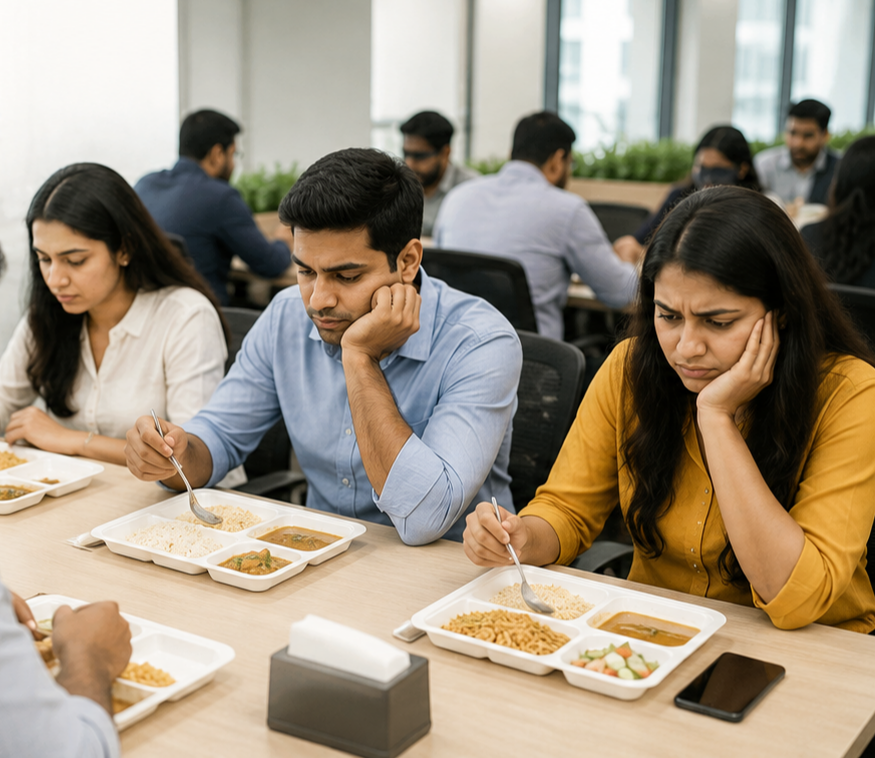
If you have ever managed food for an office in Bangalore, you already know how this story goes. The tasting session is excellent. Week one is excellent. Week three is fine. By month two the sambar has become water, the same paneer dish has appeared four times, delivery has slipped past 1:15 PM twice, and someone on the fifth floor has started a very active discussion in the office group. Nobody set out to serve bad food. The system just drifted, and nobody was watching the drift.
The short answer: consistency, not cooking
Corporate catering in Bangalore is rarely lost on flavour. It is lost on repetition of quality. A vendor who can cook a great meal once is common. A vendor who can cook the same meal to the same standard on day sixty two, in the rain, with two cooks on leave and traffic backed up on the Outer Ring Road, is rare. That gap between the tasting and the ninth week is the single biggest problem in this industry, and everything else on this list is a symptom of it.
Anyone can win the tasting. The real vendor test is what lands on the plate in week nine, on a Tuesday, when nobody senior is watching.
What actually goes wrong, in the order it usually happens
- Quality drifts quietly. Gravies thin out, protein portions shrink, and nobody can point to the day it changed
- Menus start repeating. The four week cycle becomes a two week cycle and people notice long before they complain
- Deliveries slip. A 12:45 PM promise becomes a 1:20 PM reality and lunch breaks stretch to fix it
- Dietary options get treated as an afterthought. Jain, vegan, no onion no garlic and allergy needs arrive late or not at all
- Communication breaks. Feedback goes into a WhatsApp group and disappears, and nobody owns the follow up
- Billing gets fuzzy. Headcounts, wastage and add ons are argued about at month end instead of tracked daily
Why quality drifts in the first place
It is almost never sabotage. It is margin. A vendor quotes aggressively to win a corporate account, then discovers that the price works only if the protein portion is slightly smaller, the vegetable is whichever is cheapest that week, and the gravy stretches a little further. Each individual cut is invisible. Stacked over eight weeks they add up to a plate that no longer resembles what was promised. Add staff turnover in the kitchen, where recipes live in people rather than in written standards, and drift becomes inevitable.
The Bangalore specific problems
Some of this is not the vendor's fault and it still lands on your team. Traffic is the obvious one. A kitchen in one part of the city serving a tech park in another is one accident away from a late lunch, and food that sits in transit for fifty minutes arrives tired. Then there is the sheer diversity of a Bangalore office floor. One team can easily include vegetarians, Jain diets, vegans, people avoiding onion and garlic, high protein gym goers, people managing diabetes, and colleagues from six different food cultures. A single fixed menu will fail some of them every single day.
Bangalore realities a caterer must plan around
- Traffic windows, which means kitchen location and dispatch time matter as much as the recipe
- Tech park access rules, loading bays and lift timings that can add twenty minutes on their own
- Genuinely mixed dietary needs on almost every floor, not just the occasional exception
- Hybrid attendance, where Monday and Friday headcounts can differ by forty percent
- Monsoon weeks, when both delivery and vegetable supply get less predictable
Repetitive menus are a bigger deal than they sound
Food fatigue is the quiet killer of a catering contract. People do not usually raise a ticket saying the menu is repetitive. They just start ordering from delivery apps again, and your opt in rate falls week over week until someone asks why the programme is not working. A proper rotation is not about exotic dishes. It is about a wide enough cycle, real seasonal variation, and changing the protein and the grain rather than only renaming the sabzi.
Communication is where most partnerships actually break
Every office collects feedback. Very few close the loop. The pattern we see is a WhatsApp group where complaints arrive, someone from the vendor responds politely, and nothing visibly changes. Two weeks later the same complaint returns with more people agreeing. What fixes it is boring. A named owner on both sides, feedback that is logged rather than chatted, a short weekly review of what changed, and a monthly look at opt in rate and wastage against the menu that ran.
Questions to ask before you sign a catering vendor
- How long is your menu cycle, and can I see the last eight weeks you actually served, not the sample menu
- What is the fixed protein quantity per plate, written into the contract
- Where is the kitchen, what is the dispatch time, and what is your on time delivery record for a client near us
- How do you handle Jain, vegan, no onion no garlic and allergy requests, and what is the notice period
- How do we submit headcount, what is the cutoff, and who absorbs the cost of an over forecast
- Who is my named contact, and what happens in the first hour when something goes wrong
- How do you measure wastage, and will you share that number with us every month
What a good catering partnership looks like
The offices that get this right treat catering as an operating process rather than a purchase. Meals are counted in advance with a clear cutoff, so waste stops being a mystery. Menus rotate on a published cycle that employees can see. Protein quantity is specified rather than assumed. Delivery time is a commitment with a number attached. Feedback goes into one place and gets answered with a change, not a reply. None of this is exotic, but the number of vendors doing all of it is small.
Frequently asked questions
What Bangalore office and admin teams ask us most often.
How does food quality affect employee productivity?
Nutritious, well balanced meals help employees stay energised and focused through the afternoon, while poor quality or very heavy food leads to sluggishness, longer breaks and the familiar 3 PM dip. It shows up less in headline productivity numbers and more in how the second half of the day feels.
What is a realistic per head cost for corporate catering in Bangalore?
It varies with menu type, headcount, kitchen distance and how much protein is on the plate. The useful comparison is not against zero, it is against what your team already spends on the food court and delivery apps, plus the time lost queuing for it.
How do we reduce food waste?
Count meals in advance and give people an easy way to opt out the day before. Waste in corporate catering is almost always a forecasting problem rather than a cooking problem. A daily headcount with a fixed cutoff removes most of it within a few weeks.
Should we run a trial before signing an annual contract?
Always, and make it at least two weeks rather than a single tasting. A tasting tells you what a vendor can cook. Two weeks of real service tells you whether they can repeat it, deliver on time and respond when something slips.
The biggest problem with corporate catering in Bangalore is that most vendors are set up to impress once rather than to perform for a year. Carb Theory works the other way around, with fixed protein portions, published menu cycles, headcount based planning that keeps waste low, and flexible daily and weekly options for teams. If your current programme is drifting, a two week trial is the fastest way to see the difference.
Want better meals for your team?
Carb Theory helps offices plan fresh, balanced meals with flexible daily and weekly options.