
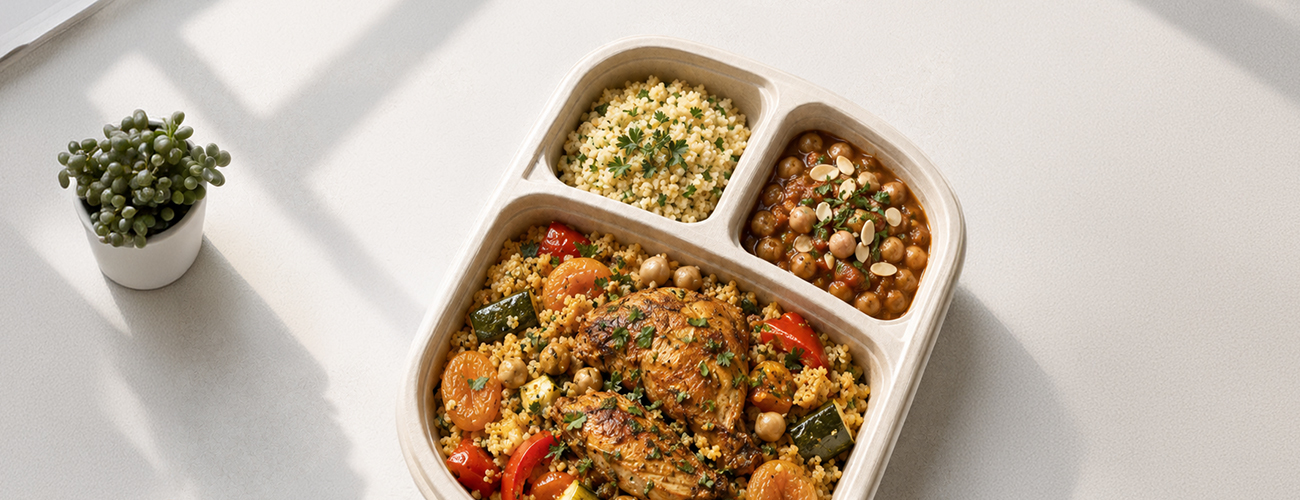
A balanced meal sounds like a nutrition textbook idea until you have to actually put one on a plate at 12:45 PM for four hundred people. Then it becomes a very practical question. How much rice. What counts as enough protein. Does ghee ruin it. Is a salad on the side doing anything. This is the exact logic we use when we plan meals at Carb Theory, written out so you can use it whether we are cooking for you or you are packing your own dabba.
Start with the plate, not the calories
Counting calories works on a spreadsheet and falls apart in a canteen queue. Proportions survive real life. Picture your plate in four parts. Half of it is vegetables. One quarter is protein. One quarter is your grain or carbohydrate. Fat comes along with the cooking rather than as a separate compartment. That is the whole framework, and it works for a South Indian meal, a North Indian thali, a bowl style lunch or whatever your kitchen is making today.
The four parts of a Carb Theory plate
- Vegetables, roughly half the plate, cooked and raw, in more than one colour
- Protein, roughly a quarter, and it must be visible rather than implied
- Slow release carbohydrate, roughly a quarter, such as millets, red rice or whole wheat
- Healthy fat, small and deliberate, from ghee, cold pressed oil, nuts or seeds
- Something fermented or hydrating on the side, usually curd, buttermilk or sambar
Protein is the part most Indian plates get wrong
This is the single biggest gap we see. A traditional office plate is often rice, a thin dal, one sabzi and a pickle. It tastes like a full meal and delivers surprisingly little protein. Protein is what keeps you full, protects muscle, and flattens the blood sugar curve so you are not hunting for biscuits at 4 PM. If you cannot point at the protein on your plate, it is not there in a meaningful quantity.
Protein that works on an Indian plate
- Thick dal, rajma, chana or lobia, cooked to actually be substantial rather than watery
- Paneer or tofu, ideally grilled or tossed rather than deep fried
- Eggs in almost any form, which are still the cheapest complete protein available
- Chicken or fish for non vegetarian tracks, gravy or dry both work
- Curd, and a good spoonful of it, not a decorative amount
If you cannot point to the protein on your plate, your plate is a carbohydrate with company.
Choosing the right carbohydrate
The grain is not optional and we do not pretend it is. What matters is which grain and how much. A slow release carbohydrate keeps energy steady for hours, which is the entire point of a workday lunch. Millets such as ragi, foxtail and little millet are local, affordable and genuinely useful in Bangalore. Red rice and hand pounded rice keep the fibre that polishing removes. Whole wheat and jowar rotis do the same job in the evening. Polished white rice is not banned, it is just portioned.
Fats are not the enemy either
Fat got demonised for a generation and the result was a lot of low fat food full of sugar. Healthy fats support hormone production, brain function, heart health and the absorption of vitamins A, D, E and K, which means a salad with zero fat is actually less useful than one with a little dressing. The catch is quantity and quality. A teaspoon of ghee on hot rice is a good decision. A deep fried side is not, and the difference is not moral, it is just volume.
Fats worth keeping on the plate
- Ghee in small measured amounts, especially with millets and rice
- Cold pressed groundnut, sesame or coconut oil for cooking
- Nuts and seeds, a small handful, not a bowl
- Coconut in gravies and chutneys, which South Indian cooking already does well
- Whole curd rather than the fat free version, since the fat helps you stay full
Vegetables do more than fill space
Half the plate sounds like a lot until you realise most of it is water and fibre. Vegetables slow digestion, feed gut bacteria, and add volume so a moderate portion of rice still feels like a full meal. The practical trick is variety and colour rather than quantity of any one thing. A cooked sabzi, a raw component such as kachumber or a simple salad, and a vegetable that is actually in season locally will beat a large heap of one boiled vegetable every time.
How this looks in a real office lunch
Take a normal Bangalore weekday. Lunch arrives at 1 PM, there is a review call at 3 PM, and the ride home starts around 6:30 PM. A plate built as ragi mudde or red rice, a thick dal or a chicken curry with real pieces in it, two vegetable sides, a spoon of curd, and a small salad will carry that entire stretch. The same day built on a large white rice portion, a watery sambar and a fried side ends with a coffee run at 3:45 PM and a very heavy dinner at 10 PM.
Build your own plate in five steps
- Pick the protein first, before you think about anything else
- Pick the grain second and serve it in a fixed bowl so the portion stays honest
- Add two vegetables, one cooked and one raw
- Add one deliberate fat, such as a teaspoon of ghee or a small handful of nuts
- Add curd or buttermilk, then eat vegetables and protein before the grain
Frequently asked questions
What Bangalore teams ask us most often about balanced meals.
Should we include healthy fats in every meal?
Yes. Healthy fats help support brain function, hormone production, heart health and the absorption of fat soluble vitamins. The quantity is what matters. Think a teaspoon of ghee or a small handful of nuts rather than a fried side.
Is this plate ratio suitable for weight loss?
It works well for it, because the ratio naturally raises protein and fibre while keeping the grain portion controlled, which is most of what makes a meal filling. You may need a slightly smaller grain portion, but the structure stays exactly the same.
What about vegetarians and vegans?
The framework does not change, only the protein source does. Dal, rajma, chana, paneer, tofu, soya and curd cover most of it. Vegans should lean on pulses and tofu and pay a bit more attention to total quantity, since plant protein portions need to be larger to match.
Can we do this with regular Indian food or does it need special ingredients?
Regular Indian food, entirely. Nothing on this plate is exotic. We are changing proportions and cooking method, not the cuisine. That is precisely why it survives contact with a real office and a real kitchen.
A balanced meal is not a diet. It is a layout. Once your team sees the same structure five days a week, the choices stop being decisions and start being habits. Carb Theory plans exactly these plates for offices across Bangalore, with flexible daily and weekly options, vegetarian and non vegetarian tracks, and portions built for a working day.
Want better meals for your team?
Carb Theory helps offices plan fresh, balanced meals with flexible daily and weekly options.