
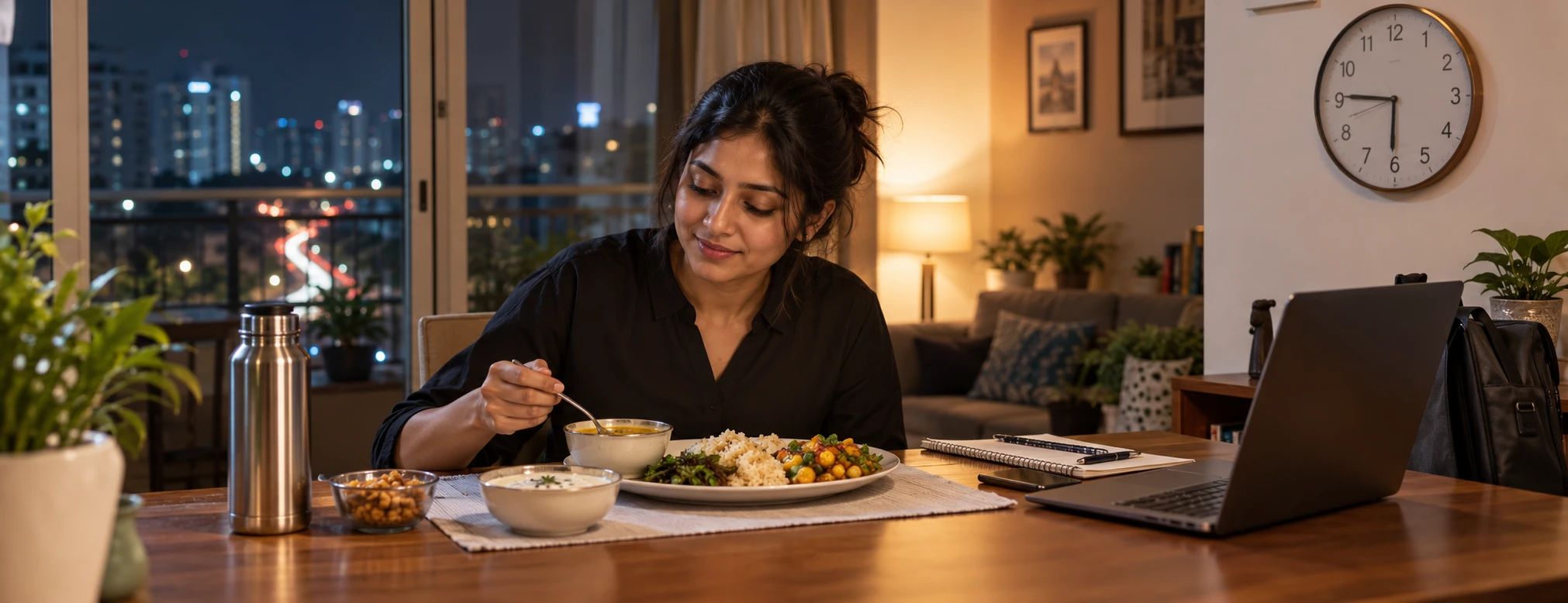
Every wellness article tells you to finish dinner by 7 PM. Every Bangalore professional reads that and laughs, because at 7 PM they are somewhere between the office gate and Silk Board. The advice is not wrong exactly, it is just written for a life nobody here is living. So let us deal with the actual question. Does a 9:30 PM dinner make you gain weight, and if it does, what can you realistically do about it when the alternative is not commuting?
The honest answer about calories and clock time
Your body does not have a rule that says calories after 8 PM count double. If total intake and food quality are held constant, meal timing has a smaller effect on weight than the internet suggests. So on a strict calories in and calories out basis, a late dinner is not the villain it is made out to be. That said, dismissing it entirely would be wrong, because late dinners change behaviour and sleep in ways that reliably lead to eating more.
A late dinner does not magically store fat. It quietly makes you eat more, sleep worse and skip breakfast, and those three do the damage.
🌙 Why Late Dinners Still Cause Weight Gain in Practice
Eating dinner late does not automatically make you gain weight. The bigger problem is what usually happens around a late dinner.
For many working professionals, especially in a city like Bangalore, late dinners often come with larger portions, poor food choices, extra snacking, and reduced sleep quality.
Here is what usually happens:
- You arrive home genuinely hungry, so the portion becomes much larger than planned.
- Cooking at 9 PM feels exhausting, so dinner becomes whatever is fastest — and that is rarely the most balanced option.
- Eating a heavy meal and going to bed soon after can affect sleep quality.
- A large late dinner can reduce your appetite for breakfast, which may lead to an oversized lunch the next day.
- Snacking while waiting for dinner adds extra calories that are easy to forget about.
The issue is often not simply what time you eat, but the chain of habits that comes with eating late.
😴 The Sleep Connection Is the Real Mechanism
This is where late dinners can create a bigger problem.
When you eat a large meal close to bedtime, your body is still actively digesting while you are trying to sleep. You may fall asleep normally, but the quality of that sleep can still suffer.
Poor sleep can influence hormones linked to hunger and fullness, including ghrelin and leptin. In simple terms, poor sleep can leave you feeling hungrier and less satisfied the next day.
That can create a cycle:
Late heavy dinner → poorer sleep → more hunger the next day → overeating → another late heavy dinner
And the cycle continues.
Interestingly, many people notice improvements in their sleep and morning energy before they notice any major change on the weighing scale.
🚗 The Bangalore Commute Problem, Stated Plainly
Imagine this.
You leave the office at 6:30 PM.
Depending on traffic, rain, and which part of Bangalore you are travelling through, you reach home somewhere between 7:45 PM and 8:45 PM.
Then you still need to cook, reheat food, or wait for a delivery.
Suddenly, dinner happens at 9:30 PM.
Add a gym session after work and dinner may easily move to 10 PM.
So telling someone in this situation to simply “eat dinner at 7 PM” is not particularly useful advice. It describes a completely different lifestyle.
The more realistic question is:
How do you reduce the negative effects of a late dinner when eating early is simply not possible?
🥗 What to Do When You Cannot Get Home Before 9 PM
A few practical changes can make a big difference.
- Eat a proper protein snack around 5 PM before leaving the office. This may be the highest-impact change you can make.
- Keep dinner moderate and protein-forward instead of eating a huge plate of rice or several rotis.
- Prep food in advance so your 9:30 PM decision becomes reheating rather than deciding what to eat.
- Avoid very fried, oily, or heavy meals late at night.
- Try to leave around 60–90 minutes between finishing dinner and lying down.
- Take a 10-minute walk after dinner, even if it is just around your home or apartment building.
- Avoid skipping breakfast the next morning just to “compensate” for the late dinner.
The goal is not perfection. It is making the late dinner easier for your body to handle.
🥜 The 5 PM Snack Deserves Its Own Paragraph
If you take only one idea from this article, make it this one:
Do not leave the office already starving.
A lot of late-night overeating starts several hours earlier.
When you reach home extremely hungry, portion control becomes much harder. You are also more likely to snack while cooking, order heavier food, or eat far faster than usual.
A simple protein-containing snack before leaving work can help break that pattern.
Good options include:
Roasted chana, boiled eggs, curd, peanuts, fruit with nuts, or a glass of milk.
It takes very little effort, costs relatively little, and can dramatically change how hungry you feel when dinner finally arrives.
For office nutrition, it is one of the simplest habits with the biggest payoff.
🥚 Good 5 PM Office Snacks
Keep it simple.
- 🫘 Roasted chana — affordable, convenient and easy to keep in your desk drawer.
- 🥚 Two boiled eggs — especially practical if your office has a refrigerator.
- 🥣 Curd or buttermilk — refreshing and easy to have during Bangalore's warmer days.
- 🥜 Peanuts or mixed nuts with fruit — simple, portable and filling.
- 🥛 Plain milk — not glamorous, but surprisingly effective.
You do not need a complicated protein bar or expensive supplement.
You just need something that stops you from reaching home ravenous.
🍽️ What a Good Late Dinner Looks Like
A late dinner should be lighter without being so small that you are hungry again at midnight.
A simple structure works well:
1. Start with protein
Choose something like:
- Eggs
- Paneer
- Dal
- Curd
- Chicken
- Fish
2. Add a moderate portion of carbohydrates
Rice or rotis are completely fine.
The goal is simply to avoid turning them into the entire meal.
3. Add cooked vegetables
Vegetables help add volume and balance without making the meal excessively heavy.
4. Add something simple like curd or buttermilk
These can work well alongside a light Indian dinner.
Try to avoid making fried sides and desserts a regular part of a 10 PM meal, particularly if you plan to sleep soon afterwards.
Simple late dinners could include:
- 🍲 Khichdi with extra dal
- 🍚 Curd rice with an egg
- 🫓 Sabzi with two rotis and curd
- 🍗 Grilled chicken with vegetables and a small rice portion
- 🥚 Egg bhurji with rotis and vegetables
Simple usually works better than elaborate when dinner is late.
🥗 How Lunch Changes Your Dinner
This part is often overlooked.
Your dinner appetite is influenced heavily by what you ate at lunch.
A balanced lunch with enough protein, vegetables, and a slower-digesting carbohydrate source can keep your energy more stable through the afternoon.
Now compare that with a food-court lunch built mostly around a large portion of white rice and a small amount of thin curry.
You may feel full immediately, but by 4 PM or 5 PM, hunger can return strongly.
Then the pattern becomes:
Large rice-heavy lunch → afternoon energy crash → fried snack at 5 PM → extreme hunger later → oversized 9:30 PM dinner
This is why your dinner size is often decided at 1 PM, not at 9 PM.
Fixing lunch can make fixing dinner much easier.
⏰ A Realistic Weekday Evening Plan
Here is a schedule that works better for someone dealing with a typical Bangalore workday.
🕔 5:00 PM
Have a protein-based office snack before leaving.
🚗 6:30 PM
Start your commute. Drink water instead of reaching automatically for a sugary drink.
🍽️ 8:30–9:00 PM
Have a moderate dinner built around protein, vegetables, and a reasonable portion of carbohydrates.
🚶 9:30 PM
Take a short 10-minute walk or simply remain upright instead of lying down immediately.
😴 11:00 PM
Aim to sleep and work towards getting around seven hours of rest.
🌅 The next morning
Have breakfast instead of skipping it to compensate for dinner.
The idea is consistency, not a perfect schedule.
❓ Frequently Asked Questions
Is there a cutoff time after which I should not eat?
There is no universal time after which food suddenly becomes bad for you.
A more practical rule is to avoid eating a very large meal immediately before bed.
If possible, leave around 60–90 minutes between your last meal and lying down, while keeping the meal relatively moderate.
For someone with a difficult commute, this is much more realistic than following an arbitrary 7 PM dinner rule.
Should I skip dinner if I get home very late?
Usually, skipping dinner is not necessary.
For many people, skipping dinner simply creates another problem: intense hunger later that night or excessive hunger the following morning.
A smaller, balanced, protein-forward meal is generally a more sustainable option than regularly skipping dinner altogether.
🔥 Does Eating Late Cause Acidity?
Late eating can contribute to reflux or acidity for some people, especially when the meal is large, oily, spicy, or followed immediately by lying down.
Keeping the meal lighter and remaining upright afterwards can help.
People who frequently experience significant acidity or reflux should speak with a qualified healthcare professional rather than relying only on meal-timing changes.
⚖️ Will Fixing My Dinner Time Alone Help Me Lose Weight?
It can help, particularly if changing dinner timing reduces overeating, snacking, or poor sleep.
But dinner timing is only one part of the picture.
If lunch is poorly balanced, protein intake is low, portions are consistently excessive, or sleep is inadequate, simply moving dinner earlier may not change much.
Fix the plate first. Then work on the clock.
🌆 Late Dinners Are Manageable
Late dinners are a reality for thousands of working professionals in Bangalore.
And they do not need to ruin your nutrition.
A protein snack before leaving work, a moderate dinner, a short period of movement afterwards, and enough sleep can handle a large part of the problem.
But one of the biggest opportunities appears much earlier in the day.
A properly balanced lunch can keep you steady through the afternoon so that when you are stuck in Bangalore traffic at 7 PM, you are hungry — not desperate.
Carb Theory builds balanced office lunches for Bangalore teams, designed to make the entire workday easier — including what happens after you leave the office.
Want better meals for your team?
Carb Theory helps offices plan fresh, balanced meals with flexible daily and weekly options.